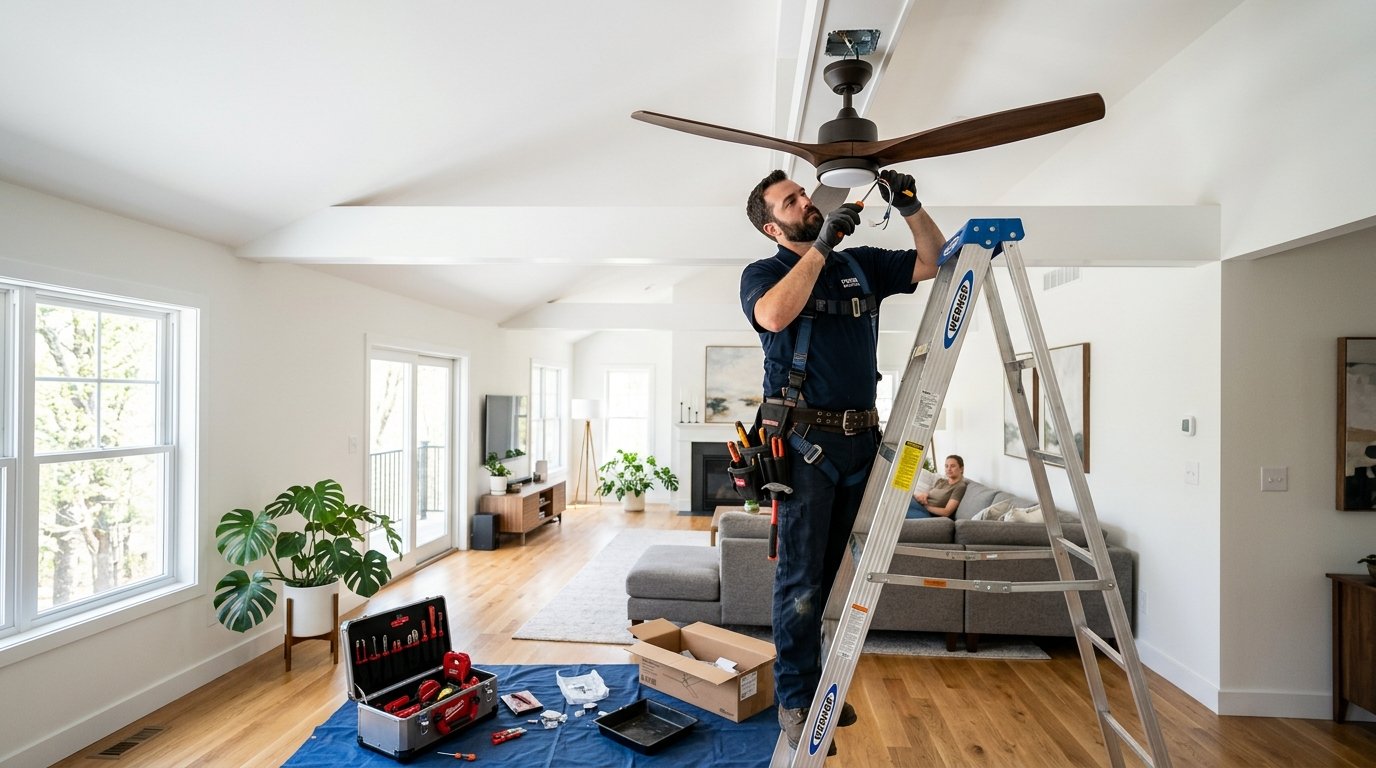
During hot, humid North Alabama summers, ceiling fans are an indispensable comfort necessity. By generating a gentle wind-chill effect, a properly installed ceiling fan makes a room feel 4 to 7 degrees cooler, allowing homeowners to set their air conditioning thermostats higher and significantly reduce electric bills from Huntsville Utilities. In the winter, reversing blade rotation gently pushes warm air trapped at the ceiling back down into living spaces.
However, installing a ceiling fan is not as simple as swapping a light bulb. Ceiling fans exert dynamic rotational torque, vibration, and substantial downward weight. Mounting a ceiling fan to an ordinary plastic or light-gauge metal light box is an illegal code violation that can cause the fan to tear free from the ceiling and cause catastrophic injury. At Huntsville Electric Pro, our partner electrical contractors install structural steel joist braces, run dedicated multi-switch wiring, and hang fans on any ceiling height with absolute stability.
Installing heavy-duty expandable steel joist braces rated to support 70+ lbs of dynamic rotating weight, guaranteeing complete structural safety.
Expert installation on 12-to-22 foot cathedral and sloped ceilings using safety scaffolding, sloped ceiling canopies, and extended downrods.
Installing weather-sealed UL damp-rated and wet-rated fans to keep Alabama mosquitoes at bay and maintain breezy patio comfort all summer.
Wiring 3-conductor branch circuits for independent wall control of light and fan motor, or programming smart Wi-Fi and handheld wireless remotes.
Achieving maximum airflow and quiet operation requires matching fan blade span to room dimensions and hanging blades at the ideal distance from floor and ceiling:
Bedrooms, home offices, and laundry rooms perform best with a compact 36" to 44" blade span for gentle, quiet circulation.
Master suites, family living rooms, and formal dining areas require a 52" to 60" fan blade diameter for optimal cubic-feet-per-minute (CFM) air movement.
Open-concept cathedral rooms and covered outdoor porches require large 65" to 72"+ architectural fans with heavy-duty DC motors.
NEC safety codes require fan blades to hang at least 7 feet above finished floor level (8 to 9 feet is optimal for airflow efficiency).
The National Electrical Code (NEC Article 314.27(C)) states that outlet boxes used as the sole support of a ceiling-suspended fan must be listed, marked by the manufacturer as suitable for this purpose, and not support ceiling fans weighing more than 70 lbs without independent structural framing support. Our licensed electricians ensure that every ceiling fan is mounted to a certified heavy-duty steel brace anchored directly to framing joists, protecting your home against vibration and falling hazards.
Almost certainly not. Standard light fixture boxes are only engineered to support stationary weights under 6 to 10 lbs. A rotating ceiling fan produces dynamic torque that will quickly loosen standard screws, cracking plaster and creating severe hazards. Our electricians replace light boxes with expandable steel fan braces anchored securely between ceiling joists.
Standard replacement on an existing fan-rated box typically costs between $140 and $250. If our electricians must install a new expandable steel brace, run new wiring to a wall switch, or assemble and hang a fan on high vaulted ceilings (requiring scaffolding or 14ft+ ladders), installation typically ranges from $275 to $550.
Yes! We specialize in high-ceiling fan installations. Our technicians use heavy-duty interior ladders and scaffolding to work safely on tall ceilings. We install heavy-duty downrods (from 24 to 72 inches) and sloped-ceiling adapter canopies to keep the fan level and provide optimal air circulation.
Outdoor covered patios and screened porches require a UL Damp-Rated ceiling fan, which features moisture-resistant ABS blades, stainless steel hardware, and protected motor housing to withstand Alabama humidity. If the fan can be directly reached by driving rain, a fully waterproof UL Wet-Rated fan is required.
Fan wobbling is typically caused by unbraced junction boxes flexing, loose blade bracket screws, or slightly unbalanced blade weights. Clicking or humming noises usually stem from loose canopy screws or pairing a motor with an incompatible standard dimmer switch instead of an inductive motor-speed control.
Yes. We install universal in-canopy wireless remote receivers that allow you to control fan speeds and dim lighting using a wireless handheld remote or wall-mounted cradle. We can also run an additional switch leg conductor to provide independent hardwired wall switches for both the light and the fan.
Enhance your home's comfort and lighting with these related services:
Leave dangerous ladder climbing and structural box bracing to licensed master electricians. Fast scheduling and upfront estimates across Huntsville, AL.