
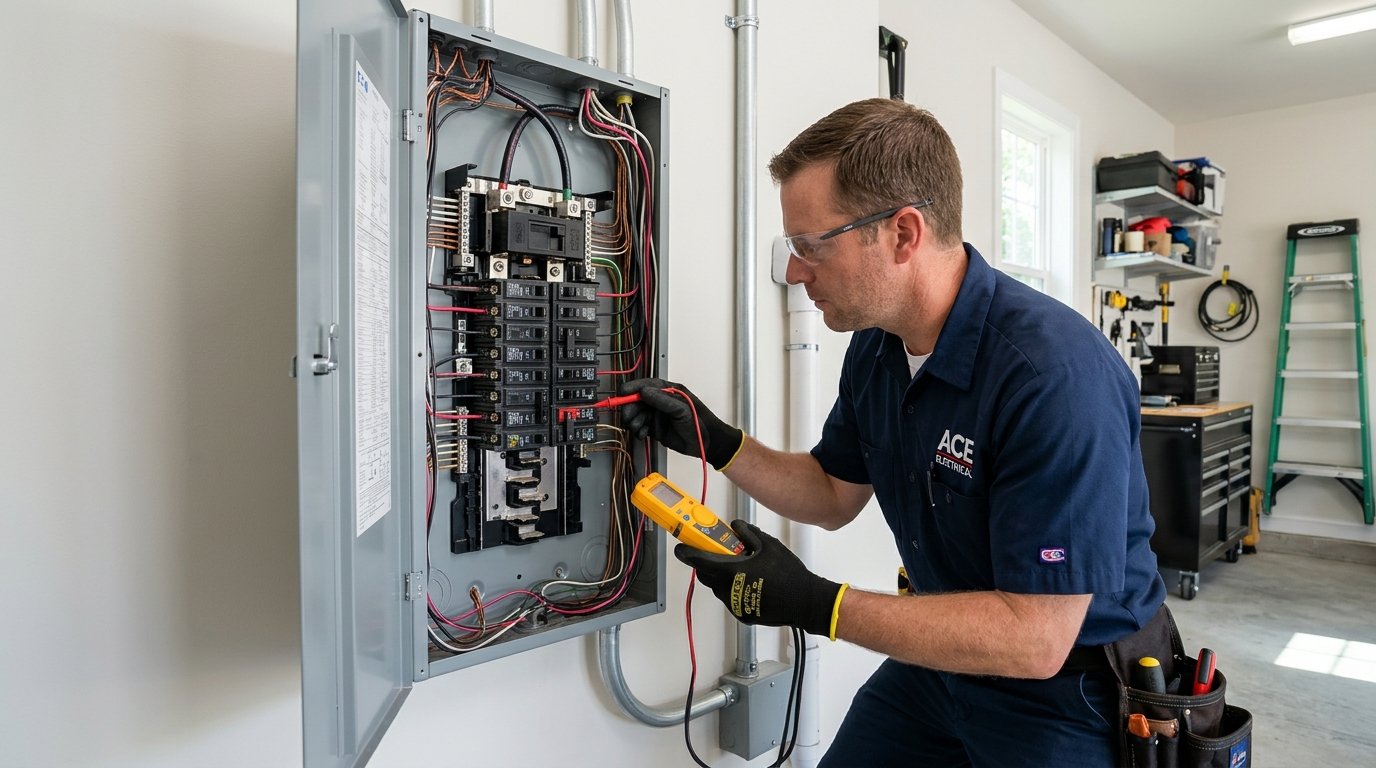
Few household occurrences are more irritating than standing in a pitch-black room, having an appliance cut off mid-cycle, or marching down into the basement or garage to flick a breaker back into the "ON" position for the third time in a single day. In Huntsville and throughout Madison County, tripping circuit breakers rank among the top reasons homeowners call for professional electrical assistance.
While flipping that small toggle switch feels like a simple minor chore, your circuit breakers are actively engineered safety devices. When a breaker cuts power, it is doing its job: stopping excessive current before the copper wiring behind your walls overheats and sparks an electrical blaze. If you find yourself frequently dealing with shutoffs, partnering with experienced licensed electricians in Huntsville, AL is the safest and most reliable way to identify the true root cause before costly structural damage occurs.
1. Circuit Overload: The Most Common Everyday Culprit
An electrical circuit overload takes place when you demand more electrical current (measured in amperes) than a specific circuit is engineered to carry. Most residential general-purpose branch circuits in Huntsville homes are wired with 14-gauge copper wire protected by a 15-amp circuit breaker, or 12-gauge copper wire protected by a 20-amp breaker.
When multiple power-hungry modern appliances—such as space heaters, air fryers, high-end microwave ovens, gaming PCs, and blow dryers—are operated on the same circuit simultaneously, total electrical demand exceeds the breaker’s safety rating. The internal bi-metallic strip heats up, bends, and triggers the trip mechanism. If this keeps happening in your kitchen, living room, or home office, relying on specialized circuit breaker repair and diagnostic services will determine whether load balancing or new dedicated lines are required.
2. Hidden Short Circuits: Dangerous Electrical Surges
A short circuit is significantly more perilous than a standard circuit overload. A short occurs when an active "hot" (black or red) wire makes accidental direct physical contact with a "neutral" (white) wire or bare conductor. This eliminates electrical resistance, prompting a sudden, massive surge of current (hundreds of amps) to rush through the system within milliseconds.
Short circuits can be caused by:
- Damaged wire insulation gnawed by rodents inside crawlspaces or attics.
- Nails or drywall screws accidentally driven through Romex cabling during home renovations.
- Loose terminal screws inside wall junction boxes or receptacles.
- Defective internal coils in power tools, blenders, or portable space heaters.
Short circuits typically trip the breaker instantly the second you try resetting it, often accompanied by a distinct "pop" sound or faint ozone burning odor. Because direct shorts carry severe fire risks, prompt inspection from a trusted provider of residential electrical repair services is critical to isolate the damaged cable run.
3. Ground Fault Surges: Moisture and Outdoor Hazards
Ground faults are specialized short circuits that happen when the live "hot" conductor touches a grounded component, such as bare copper ground wiring, the metal electrical backbox, or moist masonry. Ground faults are particularly frequent in damp environments: bathrooms, outdoor patio circuits, crawlspaces, and kitchens.
In Huntsville's humid summer months, moisture intrusion into outdoor exterior sockets or crawlspaces can easily create ground faults. Modern building codes require Ground Fault Circuit Interrupter (GFCI) protection in all moisture-prone areas. If your bathroom or outdoor circuits frequently shut off, you may need updated GFCI and AFCI outlet installation to safeguard against deadly shock hazards and nuisance tripping.
4. Aging Electrical Panels and Worn-Out Breakers
Huntsville is home to beautiful historic properties in neighborhoods like Twickenham, Old Town, and Five Points, as well as dozens of suburban neighborhoods established in the 1960s, 70s, and 80s. Electrical equipment does not last indefinitely. The mechanical springs, internal bi-metallic triggers, and busbar clips inside a circuit breaker wear out after decades of thermal cycles.
Furthermore, homes with outdated electrical load centers—or problematic obsolete panels like Federal Pacific Electric (FPE) Stab-Lok, Zinsco, or Challenger—may fail to trip when they should or trip incessantly under minimal demand. Upgrading to a modern 200-amp service via a complete electrical panel repair and replacement ensures your home can safely accommodate high-draw equipment like central HVAC systems, EV charging ports, and modern electric ranges.
"Never ignore a breaker that feels hot to the touch, hums continuously, or has visible carbon blackening on its casing. These symptoms indicate high electrical resistance at the busbar and demand immediate shutdown."
5. Outdated or Compromised Home Wiring
Another common factor in recurring breaker trips across older Alabama homes is outdated wiring infrastructure. Older properties built between the mid-1960s and early 1970s often feature aluminum branch circuit wiring. Aluminum expands and contracts at a greater rate than copper, leading to loose connections at switch terminals, oxidation, micro-arcing, and intermittent breaker trips.
In addition, ungrounded two-wire cloth-sheathed circuits struggle to handle the grounded loads demanded by modern electronics. When circuit breaker trips trace back to deteriorated wiring, investing in comprehensive whole-home electrical rewiring restores complete reliability, lowers homeowners insurance premiums, and eliminates hidden fire hazards.
Experiencing Sparks, Burning Smells, or Breakers That Won't Reset?
Do not attempt to repeatedly force a breaker that refuses to hold its position. Our dispatch line operates round the clock to connect Madison County residents with certified technicians.
Call (256) 814-8293 for Emergency Electrician DispatchHow to Safely Test and Reset a Tripped Breaker
If a breaker trips once and you want to safely check whether it was an isolated overload event, follow this standard electricians' procedure:
- Unplug connected devices: Walk into the darkened room and disconnect high-wattage items (microwaves, heaters, hair tools, computers) currently plugged into that circuit.
- Inspect your electrical panel: Open the metal door. Look down the rows of switches. A tripped breaker will usually be positioned between "ON" and "OFF", or showing an orange or red indicator window.
- Turn firmly to OFF first: Before turning it back on, firmly push the breaker handle all the way to the OFF position until you feel and hear a sharp click. This resets the internal spring mechanism.
- Switch to ON: Push the switch firmly toward the center of the panel into the ON position.
- Test device loads: Reconnect appliances one by one. If plugging in a specific appliance immediately causes the breaker to trip again, that appliance has an internal short circuit and requires repair or disposal.
When Is a Tripping Breaker an Urgent Emergency?
Certain warning signs indicate that a breaker issue has crossed the line from a minor annoyance into an active fire risk. If you notice any of the following, shut the main electrical breaker off immediately if safe to do so, evacuate the immediate area, and reach out to a 24/7 emergency electrician in Huntsville:
- The breaker trips instantaneously upon every reset attempt even with nothing plugged in.
- The breaker switch feels extremely hot or scorched to the touch.
- You detect an acrid odor of melting plastic, ozone, or burning rubber near your service panel.
- You hear audible buzzing, clicking, or sizzling sounds coming from inside the electrical panel box.
- Outlets or switches on that circuit show signs of discoloration or emit sparks.
The Golden Rule: Never "Oversize" a Tripping Breaker
One dangerous shortcut that untrained handymen sometimes recommend is replacing a tripping 15-amp breaker with a 20-amp or 30-amp breaker so that "it stops tripping." Never allow anyone to do this.
The breaker’s amperage rating is calculated precisely to protect the gauge of copper wire running through your walls. A 15-amp breaker protects 14-gauge wire. If you swap in a 20-amp breaker on 14-gauge wiring, the wire will heat to combustion temperatures, melt its insulation, and set wall studs on fire long before the oversized breaker ever trips. Code-compliant electrical safety always demands diagnosing the problem rather than masking it.
Schedule Professional Circuit Breaker Diagnostics in Huntsville
Don't let mysterious electrical problems leave your family in the dark or put your property at risk. At Huntsville Electric Pro, our network of local, certified electricians has served Madison County with transparent pricing, rapid arrival times, and meticulous diagnostic workmanship.
Whether you need a breaker replaced, a subpanel wired, or whole-home load testing, our technicians are standing by. Contact our dispatch desk today at (256) 814-8293 to book an inspection.